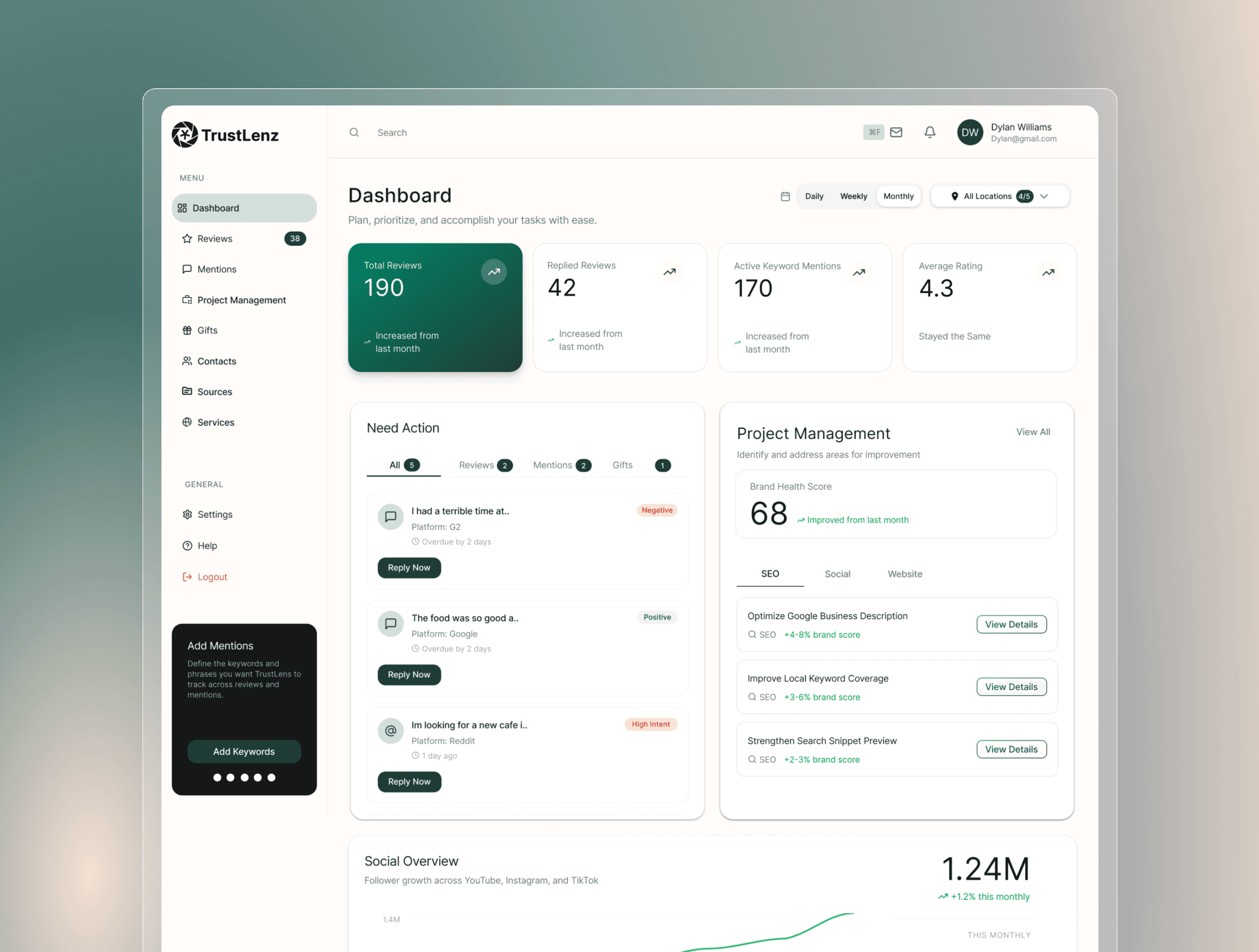
TrustLens helps businesses monitor reviews, track brand mentions, and automate customer engagement across review and social platforms.
Role:
Founding Product Designer
System Scope
Focus:
Modeling trust from fragmented signals and translating it into clear, actionable interfaces.
Duration:
Oct 2025 - Current
Status:
V1 designed · In development
/Overview
Designing a unified system for brand insight, prioritization, and action
Most brand monitoring tools give businesses more data without telling them what to do with it. Reviews, mentions, social signals, and search visibility all live in separate places, leaving teams to manually figure out what matters and when.
TrustLenz was built around a single question: how do you turn fragmented trust signals into a system that tells you what deserves attention right now?
/Early Validation
Validating demand before building
Before designing anything, we validated that the problem was real and worth solving.
We spoke with 10 existing customers from a prior product to understand how they monitored brand perception across reviews, social media, and online mentions, focusing on validating specific hypotheses rather than broad discovery.
Three customers expressed strong interest in a unified system centered on clarity and prioritization, and two committed to early agency retainers alongside product development.
This signal was sufficient to proceed, grounding early product decisions in real workflows and demonstrated willingness to pay rather than assumptions.
/Need section name
Designing a system for prioritization under uncertainty
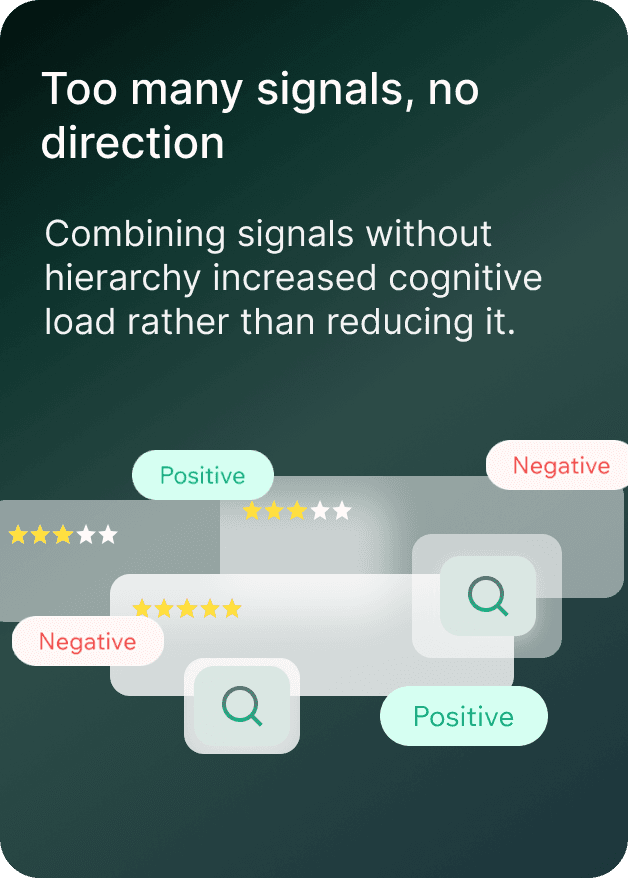
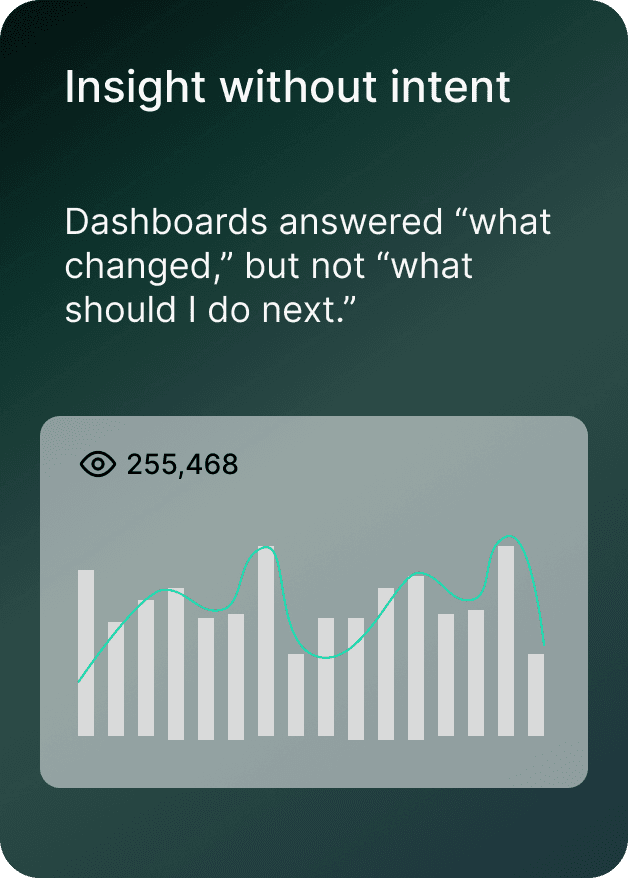
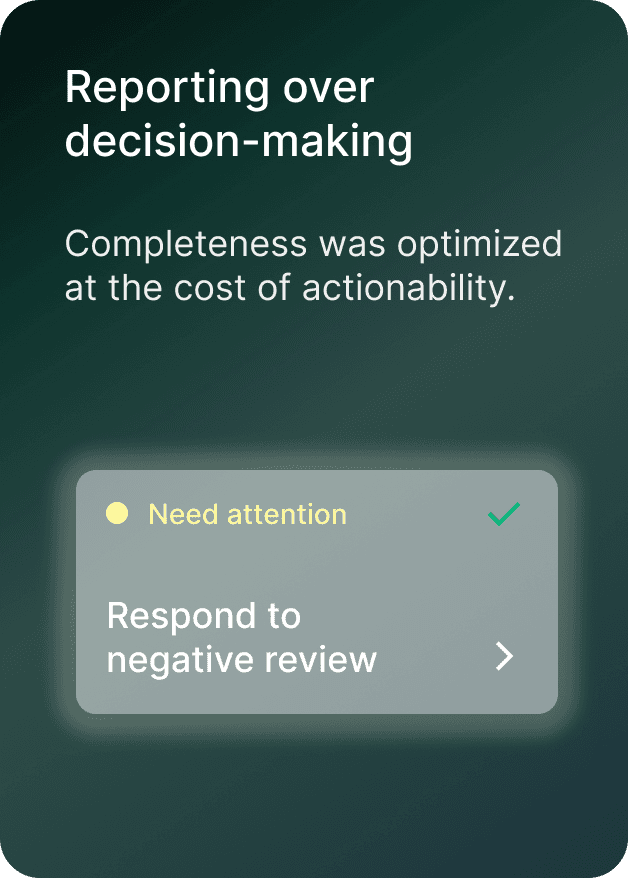
Early research showed that traditional dashboards didn't fail because of missing data. They failed because of missing direction. Teams had access to reviews, metrics, and mentions but struggled to know what deserved attention or what to do next.
TrustLenz reframed the dashboard as a decision system. Not another reporting surface, but a prioritization layer that helped users understand what mattered now, what could wait, and why.
Why traditional dashboards fall short
/Scope Decisions
Translating prioritization into a usable system
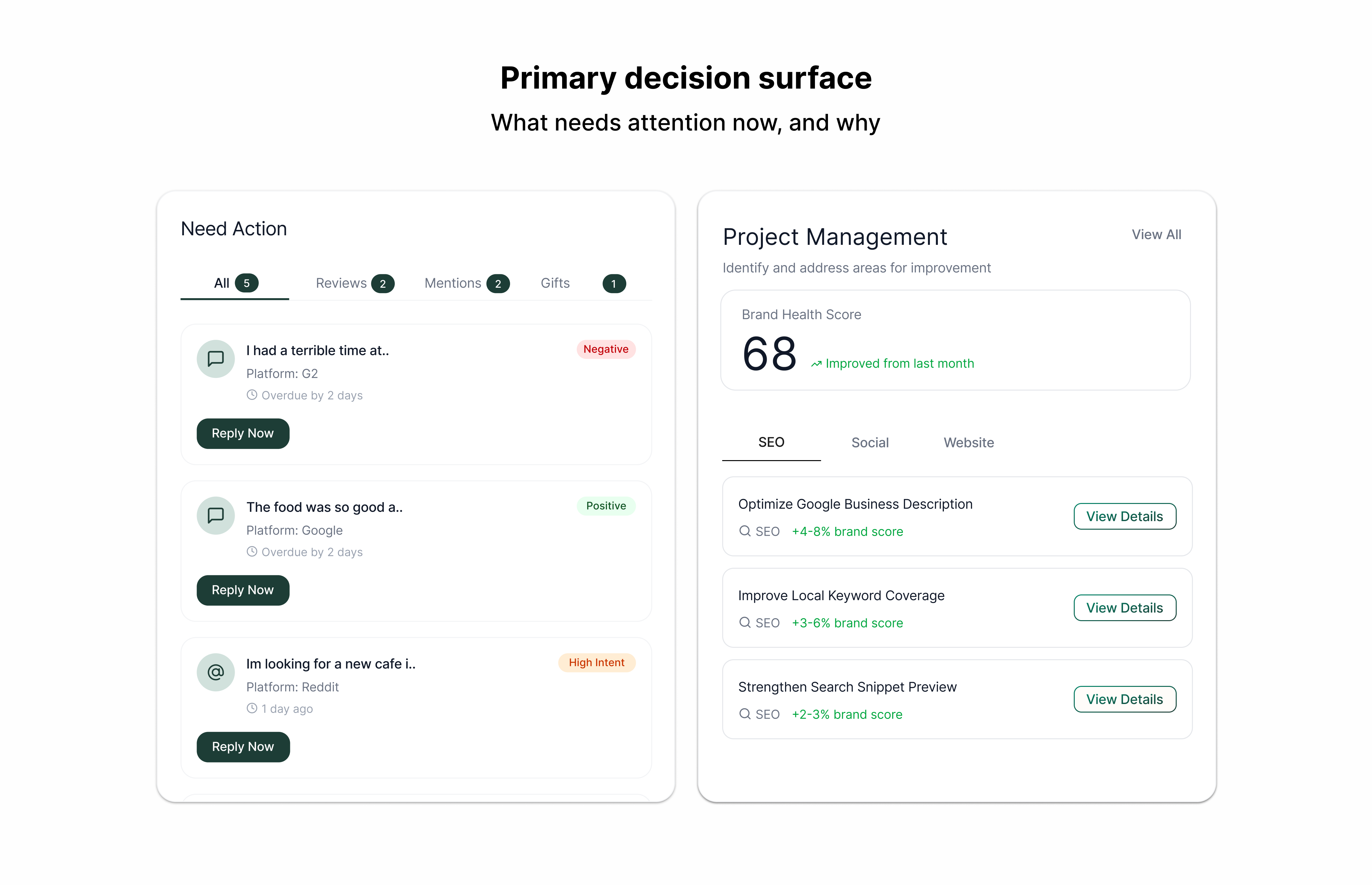
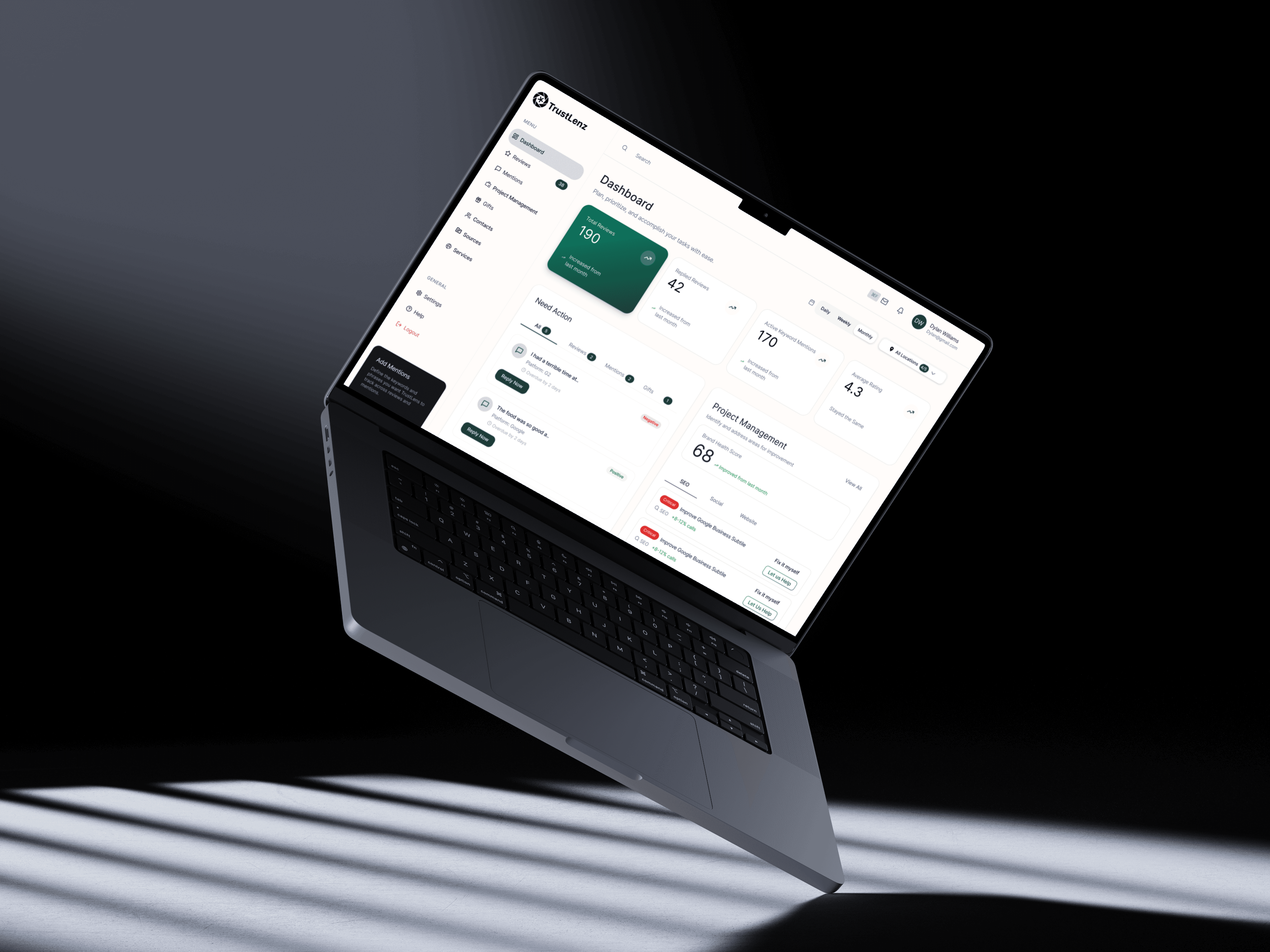
Once prioritization became the core design goal, the product architecture needed to reflect it across every surface. Instead of treating reviews, mentions, social signals, and projects as separate tools, TrustLenz organized everything around a primary decision surface focused on what required attention and what action followed.
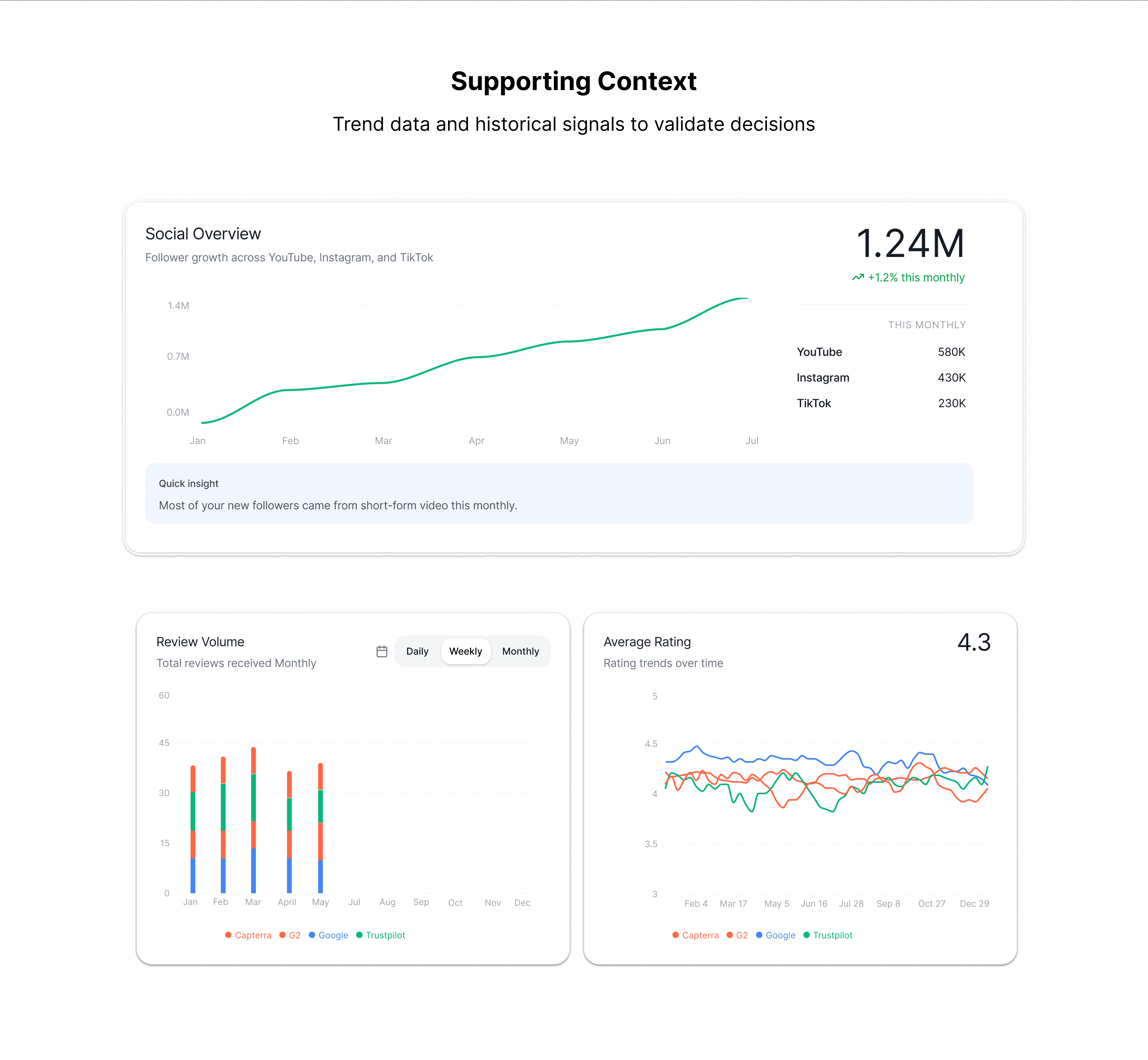
Supporting context like historical trends and aggregate metrics was intentionally secondary, used to validate decisions rather than drive them. This shifted the product from a collection of dashboards into a coordinated decision workflow.
Top of the dashboard
Middle of the dashboard
/Onboarding Tradeoffs
Sequencing early value under onboarding constraints
Because not all data sources could be integrated immediately, TrustLenz was designed to deliver value with partial setup. Low-friction social connections established early baseline insight, helping users orient quickly while deeper integrations were deferred.
This prioritized momentum and clarity over completeness, while allowing accuracy to compound over time as more data sources connected.
/Early System Behavior
Observations from early system testing
TrustLenz is still in development, but early system behavior was evaluated through internal testing and a UAT environment focused on onboarding flow and decision surface interaction.
The primary decision surface consistently served as the natural entry point. Action-oriented prompts were immediately legible, while trend views and historical context functioned as secondary validation rather than primary navigation.
Even with incomplete or simulated data, the prioritization structure remained understandable as signal depth varied. This increased confidence that a prioritization-first architecture could stay usable and credible before full data coverage.
/Early Signals
Early Signals and Open Questions
The V1 was designed as an MVP to test a specific hypothesis: that businesses would find more value in a prioritization-first system than another reporting dashboard. Early UAT observations suggested the prioritization surface was immediately legible and that users oriented around actions rather than metrics. That was encouraging.
But encouraging early signals are not the same as product market fit. We are still in the middle of figuring out the right angle. The core trust signal aggregation works, but the question of who needs it most, and whether the current framing resonates strongly enough to drive adoption, is still open.
What the process has clarified so far is what to leave out. Not every signal needs to be surfaced. Not every feature needs to ship early. Some product questions can only be answered through real usage, and we are still in that phase.
Selected Work.
© Chrisk Studio
A focused selection of product work and the decisions behind it.